







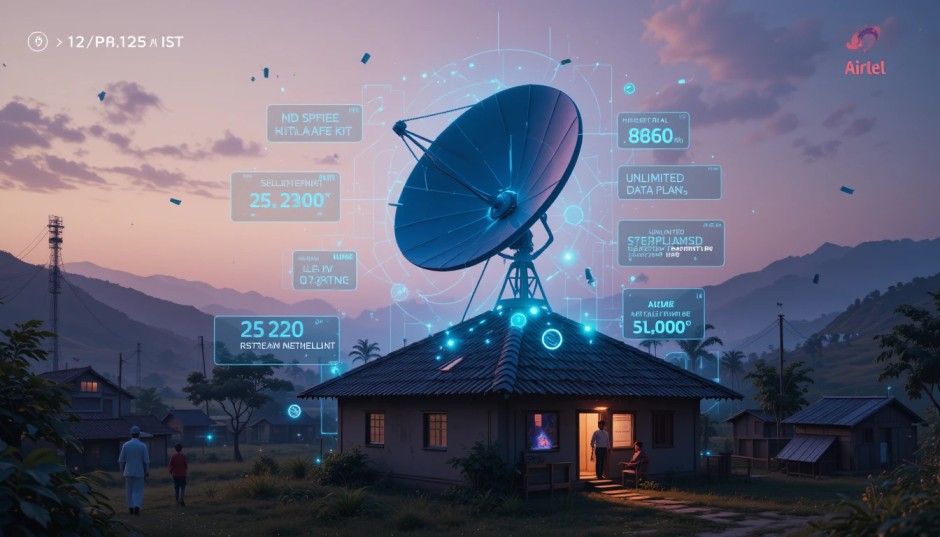
Elon Musk’s SpaceX-owned satellite internet service, Starlink, is set to launch its operations in India following the acquisition of a Global Mobile Personal Communication by Satellite (GMPCS) license from the Department of Telecommunications (DoT) in early June 2025. This marks a significant step for the company to expand its global footprint into one of the world’s largest telecom markets.
Recent reports, including insights from Business Standard and other sources, have shed light on the anticipated pricing and rollout strategy, positioning Starlink as a potential game-changer for internet connectivity, especially in rural and underserved regions. Below is a detailed breakdown of the launch plans, pricing structure, and associated factors.
Pricing Details
Starlink’s entry into India comes with a structured pricing model tailored to align with regional market dynamics rather than reflecting the country’s massive population size. The setup kit, essential for accessing the satellite-based internet service, is expected to be priced at approximately Rs. 33,000.
This kit includes critical components such as the Starlink dish, Gen 3 router, kickstand, Starlink cable, AC cable, and power supply, designed for residential use cases like streaming, video calls, and online gaming. The pricing mirrors that of neighboring countries like Bangladesh and Bhutan, where services have already been introduced, suggesting a strategy based on capacity constraints and global cost structures rather than localized market competition.

For monthly subscriptions, Starlink is reportedly planning to offer unlimited data plans starting at Rs. 3,000, with potential variations up to Rs. 4,200 depending on specific offerings or regional adjustments. This range contrasts with earlier speculations of plans as low as Rs. 850 per month, which were tied to promotional or limited-data packages.
The higher pricing reflects the premium nature of satellite internet, which is significantly more expensive than traditional terrestrial broadband services in India, often available for as little as Rs. 300 per month. However, the unlimited data plans are intended to cater to users in areas where conventional internet infrastructure is absent or unreliable.
Launch Timeline and Strategy
Reports indicate that Starlink could commence operations within the next two months, potentially by August 2025, following the receipt of its license. As part of its launch strategy, the company plans to offer a one-month complimentary trial with each device purchase, allowing users to experience the service before committing to ongoing payments.
This approach, consistent with Starlink’s global rollout model, aims to ease adoption in a market where satellite internet is a novel concept. Additionally, strategic partnerships with telecom giants Bharti Airtel and Reliance Jio, announced in March 2025, will enable the sale of Starlink hardware through their retail outlets, broadening accessibility.
Technical Capabilities
Starlink promises to deliver high-speed internet with speeds ranging from 25 to 220 Mbps, and in some cases exceeding 100 Mbps, leveraging its low-Earth orbit (LEO) satellite constellation. This network, comprising over 7,000 active satellites with plans to expand to 12,000, offers low-latency connectivity independent of fiber or mobile networks.
The service is expected to provide a bandwidth of 600 to 700 Gbps in India, targeting remote and rural areas where traditional broadband and mobile data services struggle to reach. This capability positions Starlink as a vital solution for digital inclusion, supporting applications like telehealth, education, and remote work.
Market Implications and Challenges
Starlink’s entry is poised to intensify competition in India’s telecommunications sector, joining Bharti Airtel’s OneWeb and Reliance Jio’s satellite arm as the third authorized provider of satellite-based internet. The focus on rural connectivity could address the country’s rural teledensity of just 59.26% as of April 2025, according to TRAI data.
However, the high upfront cost of Rs. 33,000 and monthly fees may limit its appeal to individual consumers, potentially making it more attractive to businesses, government institutions, and affluent households. Analysts suggest that capacity constraints could restrict Starlink to serving around 1 million connections in the short term, with potential growth to 5.7 million by 2030 if capacity increases significantly.
Regulatory hurdles remain a challenge. While the GMPCS license is a key milestone, Starlink still requires final spectrum allocation approval from the Telecom Regulatory Authority of India (TRAI) and clearance from the Indian National Space Promotion and Authorization Centre (IN-SPACe).
These steps, along with the need to establish ground infrastructure, could delay the full rollout. Additionally, telecom operators like Jio, Airtel, and Vi have raised concerns about the capacity estimates for satellite services, arguing that the planned 29,112 million GB/month could overshadow their existing 23,012 million GB/month traffic.
Benefits and Considerations
The primary benefit of Starlink is its ability to provide reliable, high-speed internet in areas where traditional infrastructure is impractical, potentially transforming access to education, healthcare, and economic opportunities. The unlimited data plans could also appeal to heavy users, though the initial investment might deter widespread adoption.
Users should be aware that pricing could evolve based on regulatory fees, including a potential 4% adjusted gross revenue (AGR) payment, an 8% license fee, and a minimum annual spectrum charge of Rs. 3,500 per block, which may influence future costs.
This launch represents a bold move by Starlink to tap into India’s vast market potential, balancing premium pricing with strategic partnerships and a trial period to drive adoption. While challenges persist, the service’s success will depend on overcoming regulatory delays and addressing the affordability barrier for the average consumer.
Related – BSNL to Install 1 Lakh New 4G Towers Across India, Invites Public to Name Its 5G Network


6 Comments
Thank you for your sharing. I am worried that I lack creative ideas. It is your article that makes me full of hope. Thank you. But, I have a question, can you help me?
Your article helped me a lot, is there any more related content? Thanks!
Thanks for sharing. I read many of your blog posts, cool, your blog is very good.
Thank you for your sharing. I am worried that I lack creative ideas. It is your article that makes me full of hope. Thank you. But, I have a question, can you help me? https://accounts.binance.info/id/register?ref=UM6SMJM3
I don’t think the title of your article matches the content lol. Just kidding, mainly because I had some doubts after reading the article.
Thanks for sharing. I read many of your blog posts, cool, your blog is very good.