

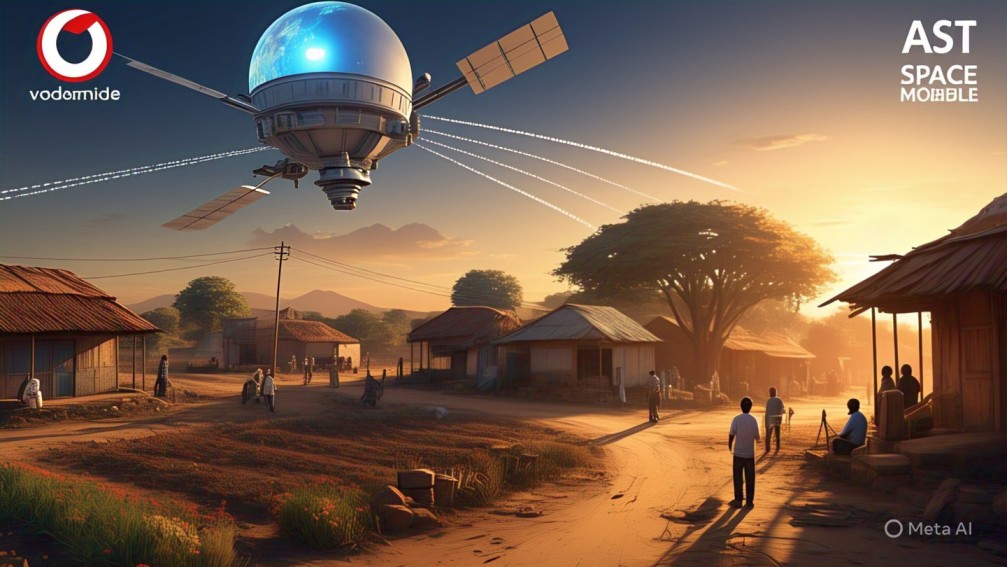
In a move that could revolutionize the way Indians connect to the internet and mobile networks, Vodafone Idea (Vi) has announced a strategic partnership with AST SpaceMobile, a U.S.-based satellite communications company. The aim? To bring direct-to-device satellite connectivity to even the most remote parts of India — without the need for special hardware.
📡What Does This Partnership Mean?
Until now, most satellite communication solutions required users to buy expensive satellite phones or bulky antennas. But AST SpaceMobile’s revolutionary BlueWalker 3 satellite technology changes all that. It allows regular smartphones — yes, the same ones we already carry in our pockets — to connect directly to satellites in low Earth orbit (LEO).
By teaming up with AST SpaceMobile, Vodafone Idea is aiming to leapfrog conventional infrastructure issues that have long plagued rural and remote areas. This means people in remote villages, forested areas, deserts, or mountainous regions might soon get mobile connectivity — even where cell towers don’t exist.
🌐Why Is This a Big Deal for India?
India is home to over 1.4 billion people, but a significant percentage still lacks reliable mobile and internet access. While cities and urban regions are saturated with 4G and even 5G towers, over 40% of rural India still struggles with dropped calls, poor internet speeds, or no connectivity at all.
This partnership could help bridge the digital divide by:
-
Connecting remote areas that are too costly or difficult to reach with traditional cell towers.
-
Enabling emergency services during natural disasters when ground networks go down.
-
Powering future use cases like smart agriculture, IoT-based rural healthcare, and e-learning.
🛰️How Will It Work?
AST SpaceMobile is building the first and only space-based cellular broadband network that connects directly to standard, unmodified mobile phones.
Here’s a simplified version of how it will work:
-
LEO satellites will orbit the Earth at altitudes of around 500–700 km.
-
These satellites act like “space cell towers” — sending and receiving signals to/from mobile phones on the ground.
-
Since they’re in lower orbit than traditional satellites, latency (signal delay) is minimal — important for voice calls and real-time applications.
AST SpaceMobile’s BlueWalker 3 satellite has already successfully demonstrated 4G LTE connectivity in field tests, including a two-way voice call using a standard smartphone, without any modifications. This was a world first — and now, Indian users are next in line to benefit.
📈Vodafone Idea’s Strategy: A Comeback in the Making?
Vodafone Idea has been under pressure for some time, losing subscribers to stronger rivals like Reliance Jio and Bharti Airtel. However, this satellite partnership could be a game-changer.
It positions Vodafone Idea as a first-mover in space-based mobile services in India, even as other telcos focus on rolling out 5G. If executed properly, this could:
-
Attract new subscribers in uncovered areas
-
Open new enterprise revenue streams (for logistics, agriculture, defense, etc.)
-
Improve Vodafone Idea’s brand perception and innovation image
Vi’s CEO Akshaya Moondra has said that this partnership will allow the company to “offer ubiquitous connectivity across India, even in the most challenging terrains.”
📅When Can Users Expect This Service?
The rollout is expected to begin in phases, subject to regulatory approvals. AST SpaceMobile plans to launch its commercial BlueBird satellite constellation starting in late 2025. Once operational, Indian users may start seeing direct-to-phone satellite services by 2026, especially in areas currently lacking 4G/5G coverage.
This timeline also gives Vi some breathing room to:
-
Sort out its ongoing financial restructuring
-
Upgrade its existing infrastructure to integrate with satellite networks
-
Prepare customer support and billing for this new category of service
🌐Global Implications — and India’s Role
Vodafone Idea is part of the Vodafone Group, which is also working with AST SpaceMobile to roll out similar services in other countries across Africa and Europe. India’s inclusion in this futuristic tech initiative is a strong signal that global companies see India as a key testbed and market for innovation at scale.
Interestingly, this also opens the door for India to compete in the space tech arena. With ISRO ramping up satellite launches and private players like OneWeb and Starlink also eyeing the Indian market, satellite broadband could become a competitive, multi-operator ecosystem in the near future.
📱What’s in It for the Everyday User?
Imagine you’re on a trek in the Himalayas, exploring a desert in Rajasthan, or living in a remote tribal village. With this new technology:
-
You’ll be able to make calls, send texts, and access the internet without needing a cell tower nearby.
-
During disasters like floods or earthquakes, when ground networks fail, you’ll still be connected.
-
Farmers could receive real-time weather updates, market prices, and government alerts right on their phones.
And perhaps the most exciting part? You won’t need to buy a new device. The service will work with standard smartphones already in circulation.
💬 Final Thoughts
Vodafone Idea’s partnership with AST Space Mobile could be a historic turning point for digital India. It promises not just better coverage, but a new era of truly universal mobile connectivity, driven by the sky above.
For a country as vast and diverse as India, satellite-based mobile networks may be the missing link in achieving true digital inclusion. If all goes well, the dream of “no Indian left offline” may finally become a reality — and Vodafone Idea may be the unlikely hero leading the charge.
Related – Starlink Set to Launch in India with Rs. 33,000 Kit and Unlimited Plans from Rs. 3,000

1 Comment
Your point of view caught my eye and was very interesting. Thanks. I have a question for you.